
Gujarat is once again looking east for its next wave of industrial growth. Deputy Chief Minister Harsh Sanghavi is on an official visit to Japan, and on Tuesday, 20 October, he led a packed day of 11 high-level meetings across Tokyo and Shizuoka.
The goal is clear. Gujarat wants to bring more Japanese capital, technology and expertise into the state, and it wants global investors at the upcoming Vibrant Gujarat Global Summit.
Here is a complete look at what happened during the Harsh Sanghavi Japan visit, who he met, and why it matters for Gujarat’s economy.
A Packed Day: 11 Meetings in Tokyo and Shizuoka
The schedule for 20 October was dense and carefully planned. The 11 engagements included:
- Seven one-to-one meetings with leading Japanese companies
- Two government and bilateral meetings
- One textile industry roundtable
- One official dinner
The meetings were spread across two key locations. Tokyo, Japan’s corporate and financial hub, hosted the business sessions. Shizuoka, an important industrial prefecture, was the venue for the state-to-state dialogue.
This mix of corporate, government and sector-focused meetings shows a structured approach. Gujarat is not just seeking investment from individual companies. It is also building long-term institutional ties with Japanese regional governments.
Why Japan Matters to Gujarat
Japan and Gujarat already share a strong economic relationship. Several major Japanese manufacturers operate in the state, especially in the automobile and auto-component space. Japanese technology is also behind the Mumbai–Ahmedabad high-speed rail project, which runs through Gujarat.
The Vibrant Gujarat Global Summit has long served as a platform for Japanese participation. With the next edition approaching, the state government wants to deepen these links further.
Sanghavi’s visit has two clear objectives:
- Attract global investors to Gujarat ahead of the summit.
- Strengthen Gujarat–Japan economic relations across manufacturing, technology, energy and trade.
Key Business Meetings in Tokyo
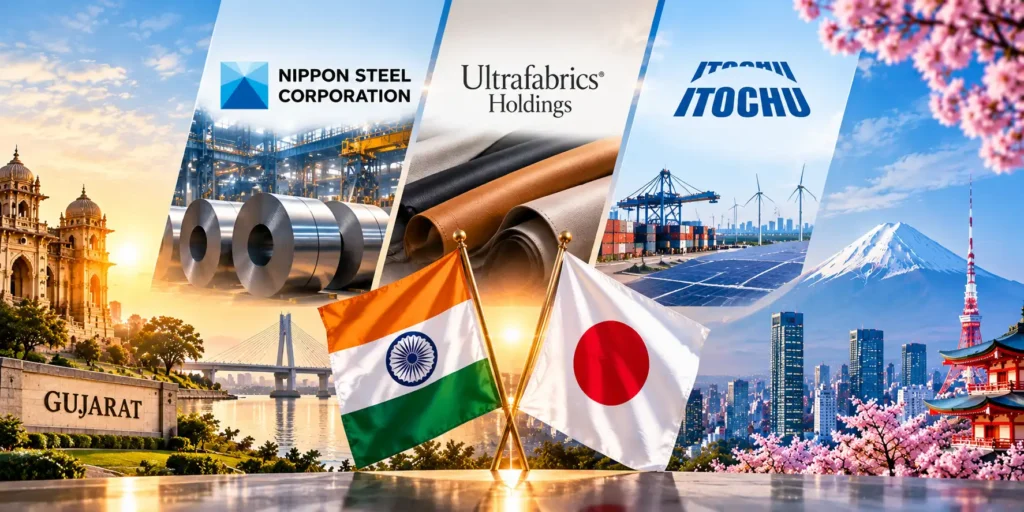
The first session of the day saw four major meetings with some of Japan’s best-known corporations. Each focused on a specific sector where Gujarat sees growth potential.
Nippon Steel Corporation: Expanding Steel Production
The delegation visited the Nippon Steel Corporation headquarters. There, Sanghavi met Chairman Eiji Hashimoto, Managing Executive Officer Hideki Ogawa, and other senior executives.
The discussion centred on possibilities for expanding steel production in Gujarat. Steel is a backbone industry for infrastructure, automobiles and construction. Any expansion by a global leader like Nippon Steel could have a significant ripple effect on the state’s industrial base.
Ultrafabrics Holdings: Synthetic Leather
Sanghavi held talks with Ultrafabrics Holdings Chairman Yoshimura. The conversation explored investment opportunities in synthetic leather and related sectors.
Synthetic leather is widely used in automotive interiors, furniture and fashion. Gujarat’s growing automobile and textile ecosystem makes it a natural fit for this industry.
Kaneka Corporation: Chemicals and Life Sciences
The delegation met Kaneka Corporation President Isao Otsu (as named in official reports). The focus was on strengthening partnerships with Gujarat in the chemical and life sciences sectors.
Gujarat is already one of India’s leading chemical and pharmaceutical hubs. A deeper tie-up with Kaneka could add advanced materials and life science capabilities to the state’s existing strengths.
Itochu Corporation: Green Energy and Global Trade
Senior officials of Itochu Corporation, one of Japan’s largest trading houses, also met the delegation. Talks covered cooperation in green energy and global trade.
Gujarat has positioned itself as a leader in renewable energy, with large solar and wind capacity. Partnering with a global trading company like Itochu could help open new export channels and clean energy investments.
Hi-Reso: Cloud Computing and GCCs
Beyond the four main meetings, the delegation also held discussions with Hi-Reso. The talks focused on cloud computing and Global Capability Centres (GCCs).
GCCs are offshore technology and operations centres set up by multinational companies. Gujarat, with GIFT City and a growing tech talent pool, is keen to attract more of these high-value facilities.
Bilateral Meeting With the Governor of Shizuoka
After the Tokyo sessions, Sanghavi was scheduled to travel to Shizuoka by bullet train (Shinkansen). The choice of travel itself carries symbolic weight, given Japan’s role in India’s own bullet train project.
At the Shizuoka Prefectural Government Building, a bilateral meeting was planned with Governor Yasutomo Suzuki. The agenda included:
- Industrial development in both regions
- Modern technology collaboration
- Mutual cooperation opportunities between Gujarat and Shizuoka
The Governor was also to be formally invited to the Vibrant Gujarat Global Summit.
State-to-prefecture ties like this can create lasting frameworks for trade, skill exchange and industrial partnerships. They often outlast individual corporate deals.
More Sector-Focused Talks: Electronics, Auto Parts and Carbon Credits
The next phase of the visit included meetings with companies from three very different sectors.
Fujifilm Corporation
Discussions with Fujifilm Corporation were set to focus on electronic materials and investment possibilities. As India pushes semiconductor and electronics manufacturing, Gujarat is working to build a full supply chain. Electronic materials are a critical part of that chain.
Yazaki India Private Limited
Meetings were also scheduled with Yazaki India Private Limited, a company in the auto component sector. Gujarat’s established automobile manufacturing base creates steady demand for quality components.
Green Carbon
The delegation was also set to meet representatives of Green Carbon, a company working in the carbon credit sector. Carbon markets are growing fast as industries look to meet climate targets. This conversation shows Gujarat’s interest in sustainability-linked investment, not just traditional manufacturing.
Textile Roundtable: Showcasing Gujarat’s New Textile Policy
One of the highlights of the day was a high-level roundtable with Japanese investors and textile industry representatives.
At this session, the Gujarat delegation planned to present:
- The state’s modern textile ecosystem
- Gujarat’s new textile policy
- Global export opportunities from the state
Japanese companies were to be invited to invest in Gujarat and take part in the Vibrant Gujarat Global Summit.
Textiles have deep roots in Gujarat, from Surat’s synthetic fabric industry to Ahmedabad’s historic mills. Combining this base with Japanese technology in technical textiles and advanced fabrics could unlock new value.
Special Dinner at India House, Tokyo
The day was set to close with a special dinner hosted by India’s Ambassador to Japan at India House in Tokyo. The dinner was organised in honour of Deputy Chief Minister Harsh Sanghavi and the Gujarat delegation.
Such diplomatic gatherings help build personal rapport between Indian officials and Japanese business leaders. They also signal strong central government support for the state’s outreach.
What This Visit Means for Gujarat’s Economy
The Harsh Sanghavi Japan visit reflects a focused, sector-by-sector investment strategy. The meetings covered a wide range of industries:
| Sector | Company / Partner |
| Steel | Nippon Steel Corporation |
| Synthetic leather | Ultrafabrics Holdings |
| Chemicals & life sciences | Kaneka Corporation |
| Green energy & trade | Itochu Corporation |
| Cloud computing & GCCs | Hi-Reso |
| Electronic materials | Fujifilm Corporation |
| Auto components | Yazaki India |
| Carbon credits | Green Carbon |
| Textiles | Japanese textile investors |
| Government ties | Shizuoka Prefecture |
This spread shows that Gujarat is looking beyond traditional heavy industry. It is targeting future-ready sectors like cloud services, clean energy, carbon markets and advanced materials.
If even a few of these conversations turn into investment commitments, the impact could include new factories, jobs, technology transfer and stronger exports.
Looking Ahead to the Vibrant Gujarat Global Summit
Every meeting on this tour ties back to one larger event: the Vibrant Gujarat Global Summit. The summit is the state’s flagship platform for announcing investments and signing agreements.
By meeting company leaders and government officials in person, Gujarat is laying the groundwork early. The outcomes of these talks may well show up as MoUs and investment announcements at the summit.
For businesses and investors watching Gujarat, this visit is a strong signal. The state is actively seeking partners, and Japan remains one of its most important.
Frequently Asked Questions (FAQs)
He is visiting Japan to attract global investors to Gujarat and strengthen Gujarat–Japan economic ties ahead of the Vibrant Gujarat Global Summit.
A total of 11 meetings were held in Tokyo and Shizuoka, including seven one-to-one meetings, two bilateral meetings, a textile roundtable and an official dinner.
Key companies included Nippon Steel, Ultrafabrics, Kaneka, Itochu, Hi-Reso, Fujifilm, Yazaki India and Green Carbon.
The talks focused on possibilities for expanding steel production in Gujarat.
A bilateral meeting was planned with Shizuoka Governor Yasutomo Suzuki to discuss industrial and technology cooperation.