
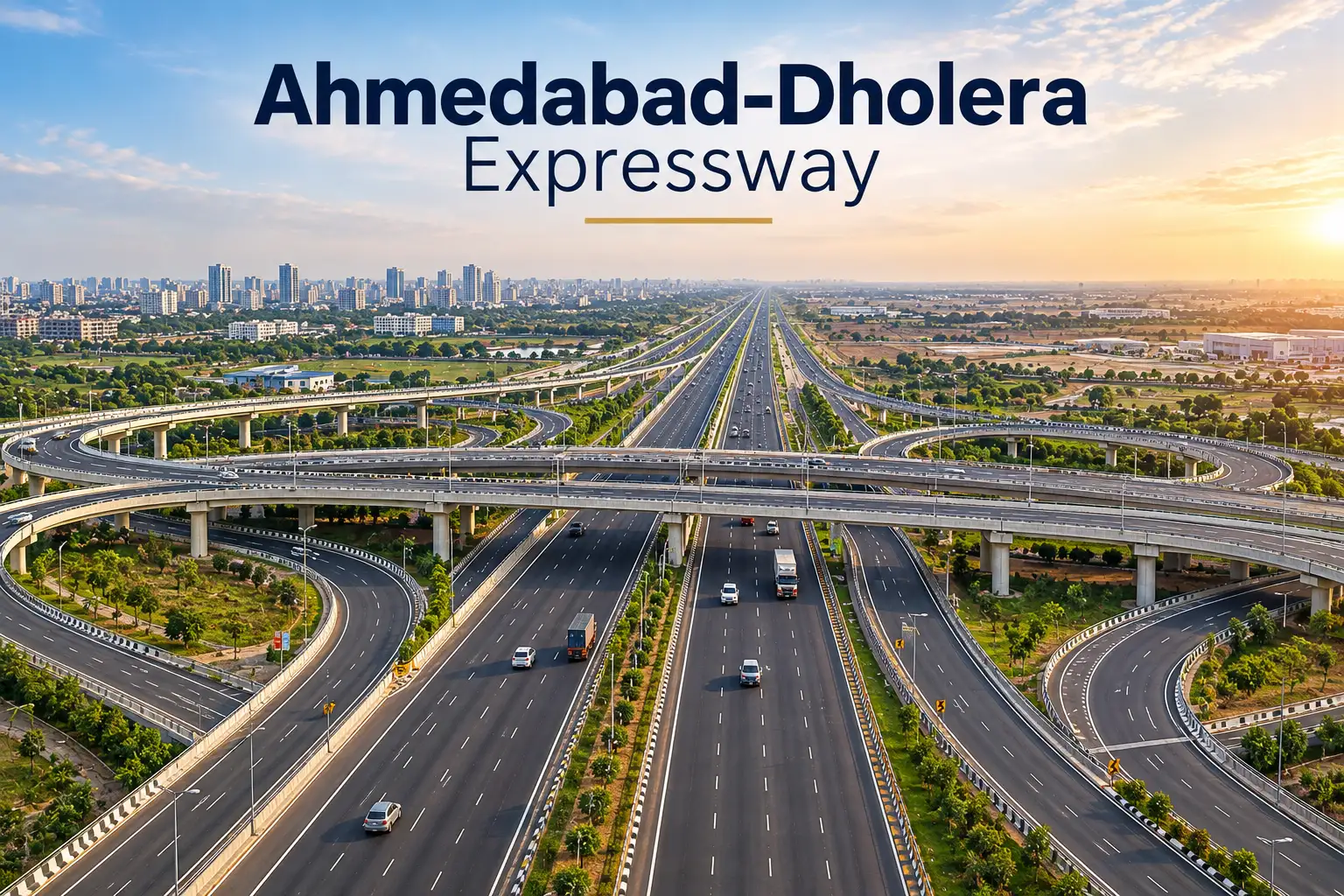
Gujarat’s newest high-speed corridor is finally getting the link it has been waiting for. The National Highways Authority of India (NHAI) has invited bids for a dedicated interchange where the Ahmedabad-Dholera Expressway meets the Sardar Patel Ring Road (SPRR) — a junction crossed daily by commuters, freight operators and Dholera-bound investors.
Here is what the tender reveals, and why this single interchange matters far more than its price tag suggests.
A ₹124.40 Crore Interchange Enters the Tender Stage
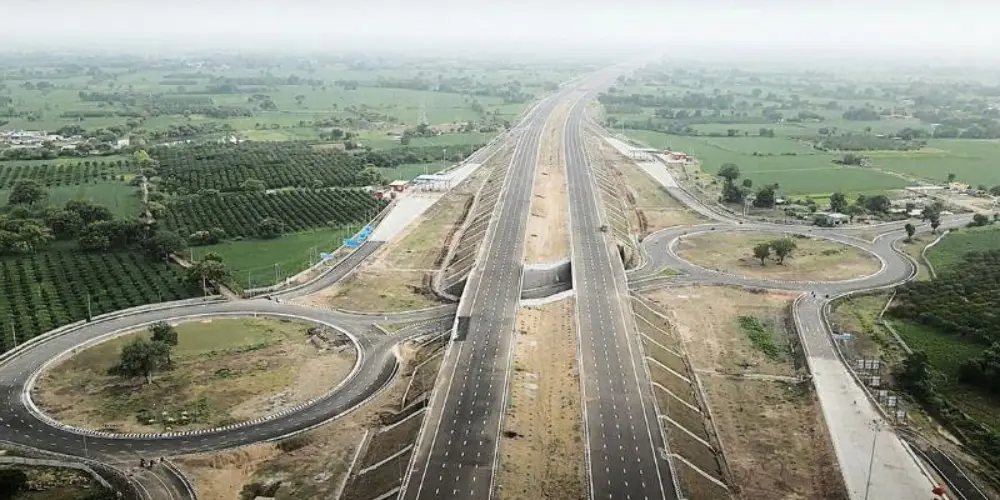
NHAI has issued a bid notice for constructing an interchange at the point where the Ahmedabad-Dholera Expressway crosses the SP Ring Road. The headline numbers:
- Estimated cost: ₹124.40 crore, excluding GST
- Execution mode: Engineering, Procurement and Construction (EPC)
- Construction period: 18 months
- Maintenance period: 10 years
- Bid opening date: October 23, 2026
The EPC route puts design and delivery risk on the contractor at a fixed price — a model NHAI leans on to keep highway timelines tight. The unusually long 10-year maintenance window signals that the authority expects heavy, sustained traffic here rather than light slip-road use.
Inside the Design: Ramps, Service Roads and Two Key Directions
The layout is compact but purposeful. Instead of a sprawling cloverleaf, NHAI has planned a directional scheme built around two ramps and parallel service roads.
- Ramp-1: connects Bakrol towards Dholera
- Ramp-2: connects Dholera towards Sanathal
- Service roads: on either side, to absorb local and slow-moving traffic
- Objective: smoother movement between the expressway and the existing ring road network
The service roads are the quiet hero. By separating local Ahmedabad traffic from expressway-speed vehicles, the design removes the weaving and merging conflicts that usually turn a fast corridor into a slow one at its entry points.
Why This Junction Was the Missing Link
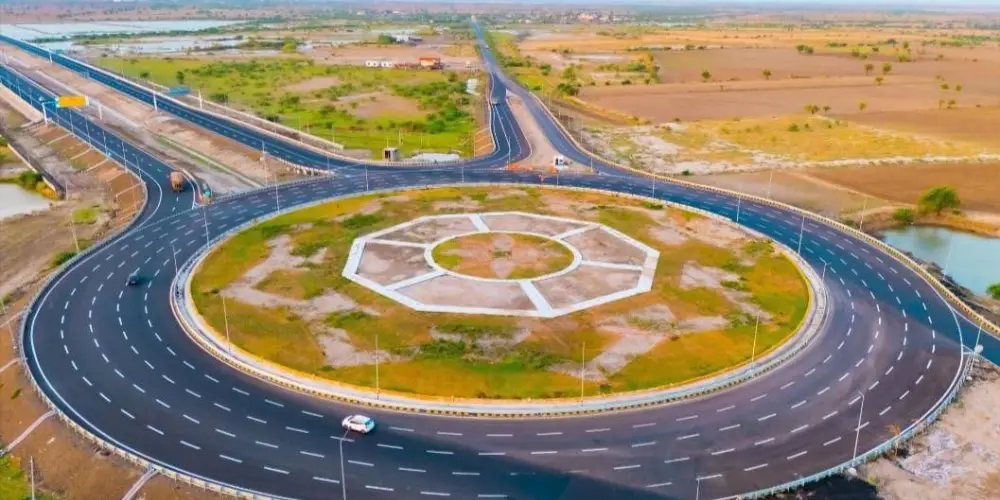
The SP Ring Road is Ahmedabad’s primary orbital route, feeding the Ahmedabad-Dholera Expressway from every direction of the city. Until now, movement between the two has relied on at-grade arrangements that dilute the time savings the corridor was built to deliver.
An interchange fixes three things at once:
- Removes the bottleneck at the busiest access point of the route
- Protects travel-time gains, so the 45-minute Ahmedabad–Dholera run holds up at peak hours
- Improves freight flow for trucks heading to industrial clusters along the western belt
For a road designed for uninterrupted high-speed movement, the entry point had become the weak spot. This tender addresses it head-on.
The 109-km Corridor Behind the News
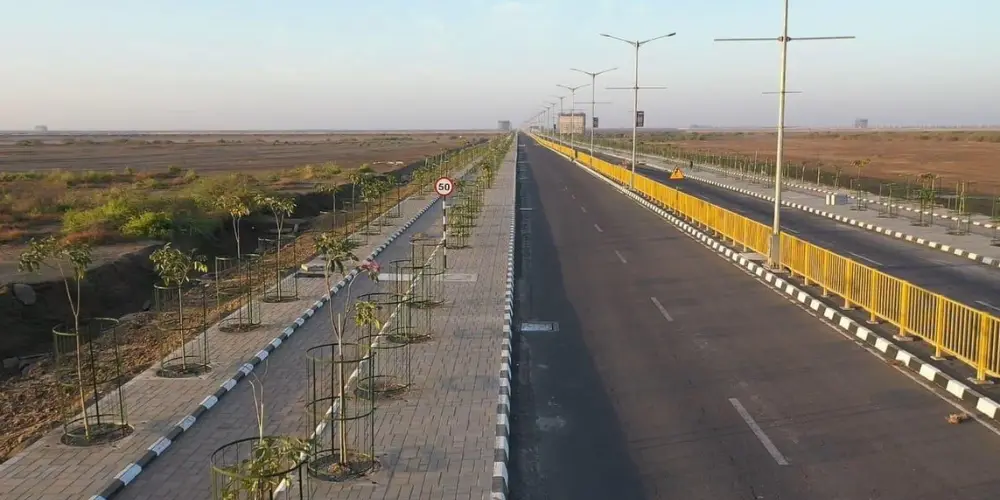
The Ahmedabad-Dholera Expressway is a 109.019-km greenfield corridor designated NE-8, inaugurated earlier this year at a cost of ₹5,800 crore. It was conceived as the spine connecting Ahmedabad to the Dholera Special Investment Region (DSIR).
Key facts worth knowing:
- Length: 109.019 km, fully greenfield alignment
- Cost: ₹5,800 crore
- Travel time: Ahmedabad to Dholera cut to around 45 minutes
- Wider reach: improved connectivity towards Bhavnagar
- Strategic link: direct access to the upcoming Dholera International Airport
A greenfield alignment matters because it avoids the land-acquisition drag and traffic disruption of widening an existing road, allowing consistent design speeds end to end.
Built Green: Waste and Fly Ash Turned Into Highway
One of the most striking aspects of the Ahmedabad-Dholera Expressway is how it was built. The project followed an environment-focused approach that turned urban waste into road-building material.
- 60 lakh metric tonnes of municipal waste reused
- 22 lakh metric tonnes of fly ash consumed in construction
- Extensive plantation carried out along the alignment
The scale is significant. Diverting millions of tonnes of legacy waste and thermal-plant fly ash into embankments eases landfill pressure, cuts demand for fresh aggregates and lowers the carbon footprint of a project this size. It makes the corridor a working template for how Indian infrastructure can pair faster travel with economic growth and environmental responsibility.
What It Means for Dholera SIR and Regional Investment
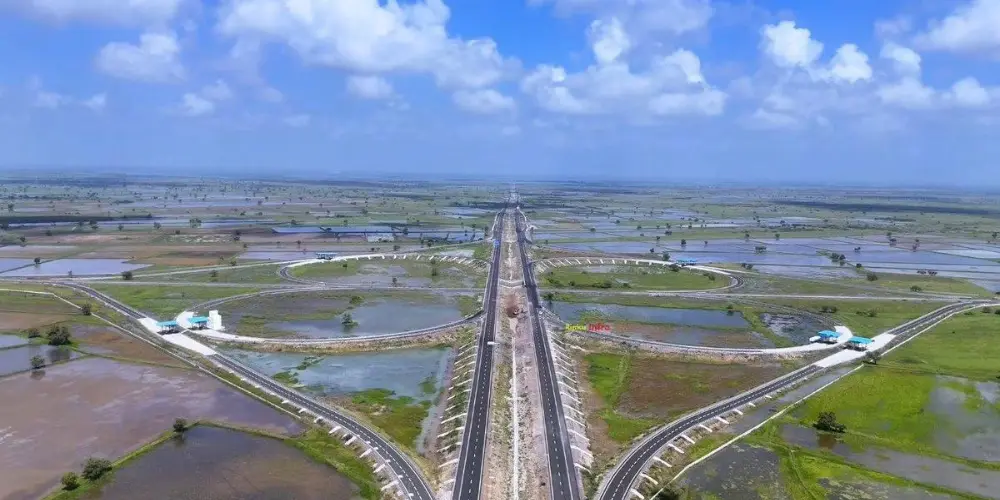
Dholera SIR is being developed as one of India’s flagship greenfield industrial cities, anchored by semiconductor manufacturing plans, planned townships and a new international airport. Connectivity is the single biggest variable in whether such a region attracts capital.
The Ahmedabad-Dholera Expressway has already moved that needle:
- Investor confidence has risen since the expressway opened
- Site access for industrial and logistics players has improved sharply
- Airport linkage strengthens Dholera’s case as a business destination
- Land and real estate interest along the alignment continues to build
The interchange compounds these gains. When a factory manager in Ahmedabad can reach a Dholera site in under an hour without hitting a congested junction, the region stops feeling remote and starts feeling like a suburb of opportunity.
What Happens Next
The immediate milestone is the bid opening on October 23, 2026. From there comes contract award, mobilisation and an 18-month construction clock, followed by a decade of contractor-backed maintenance.
For commuters, developers and logistics operators tracking the Ahmedabad-Dholera Expressway, this is a tender worth watching — small in cost, outsized in effect.
FAQs
₹124.40 crore, excluding GST, to be executed under EPC mode.
The construction period is 18 months from award, with a 10-year maintenance period.
Bids are scheduled to be opened on October 23, 2026.
Ramp-1 will connect Bakrol towards Dholera, and Ramp-2 will connect Dholera towards Sanathal, supported by service roads on both sides.
It runs 109.019 km, is designated NE-8, and was built at a cost of ₹5,800 crore.