
Introduction
Every smart city pitch begins with roads, power and connectivity. But ask any industrial developer what actually decides whether a plot is investable, and the answer is usually simpler: is there water, and will it arrive at pressure, every hour of every day?
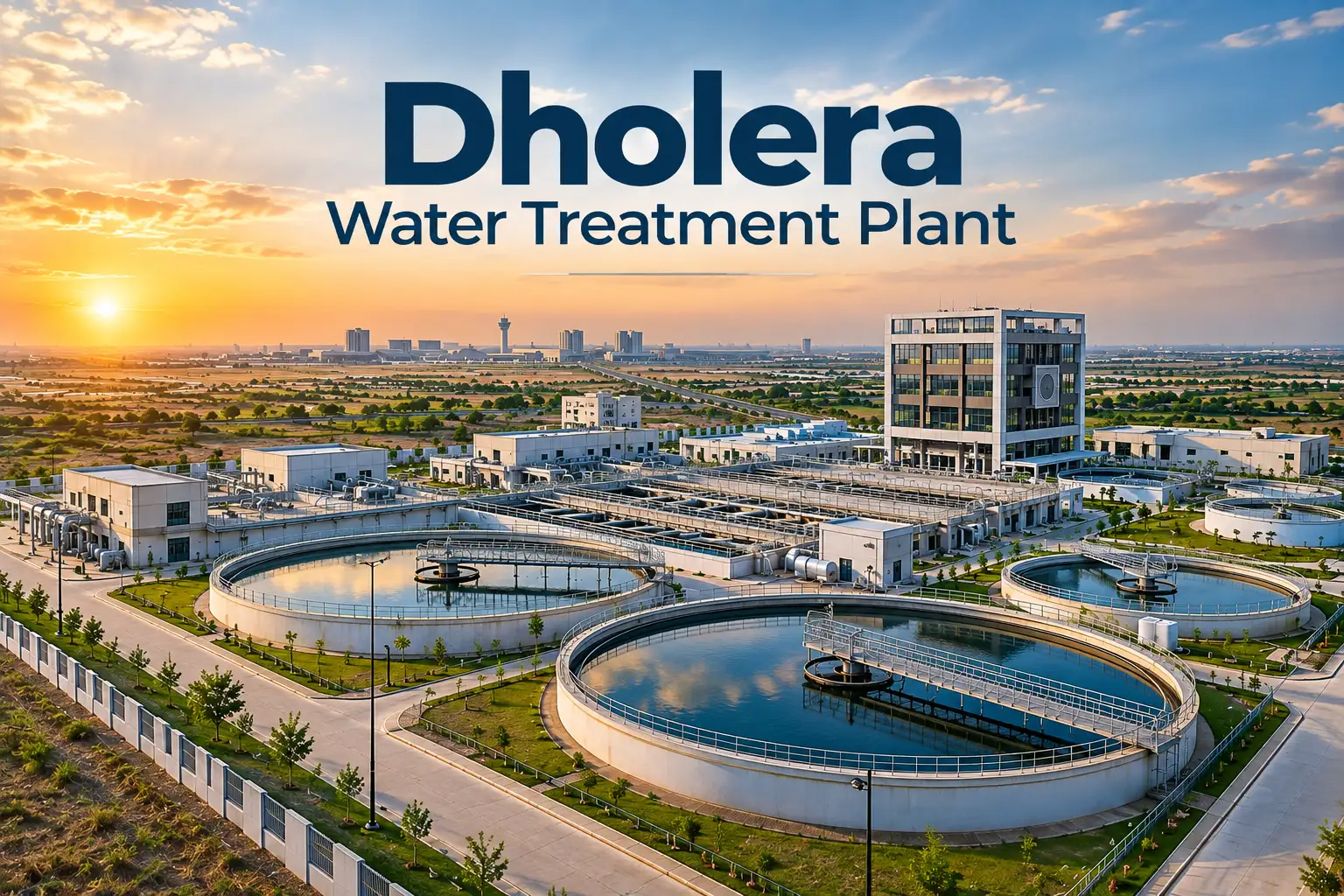
In Dholera Special Investment Region — India’s largest greenfield planned city, taking shape in Gujarat’s Ahmedabad district — that question already has an answer. The Dholera Water Treatment Plant is a 50 MLD (million litres per day) facility built not as an afterthought, but as a designed-in utility laid down before the first factory gate opened. It is engineered to be augmented to 150 MLD as demand grows, and it feeds a distribution system built for consistency rather than improvisation.
Here’s how it works, and why it matters.
Water Is the Constraint That Decides Industrial Viability
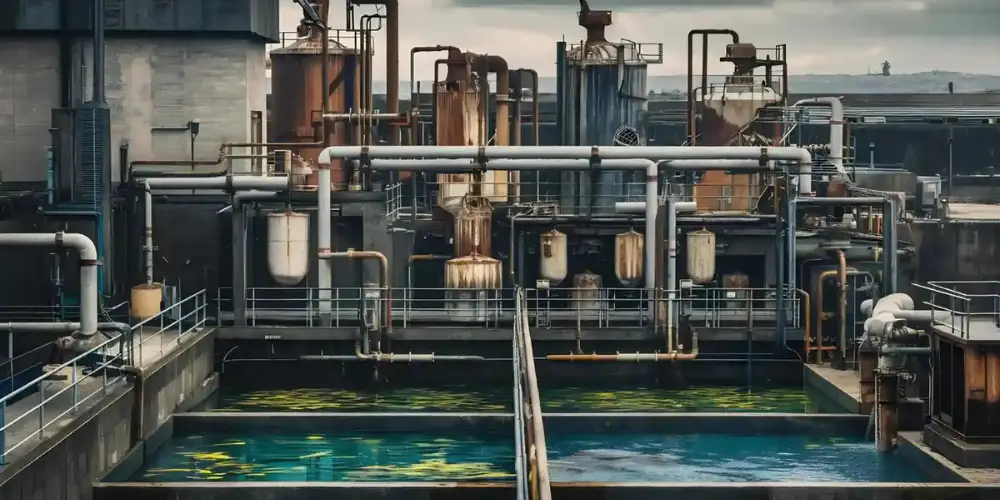
Industrial users are far more water-sensitive than residential ones. A semiconductor fab, a pharma unit, a food processing line or a textile plant each carries a non-negotiable water profile — volume, quality, continuity.
- Water shortfalls stop production lines faster than power fluctuations do
- Inconsistent pressure damages process equipment and forces on-site storage investment
- Retrofitting water capacity into a built-up city is slow and expensive
By treating water as core infrastructure rather than a follow-on service, Dholera removes a variable that most Indian industrial locations ask investors to absorb themselves.
Inside the 50 MLD Water Treatment Plant
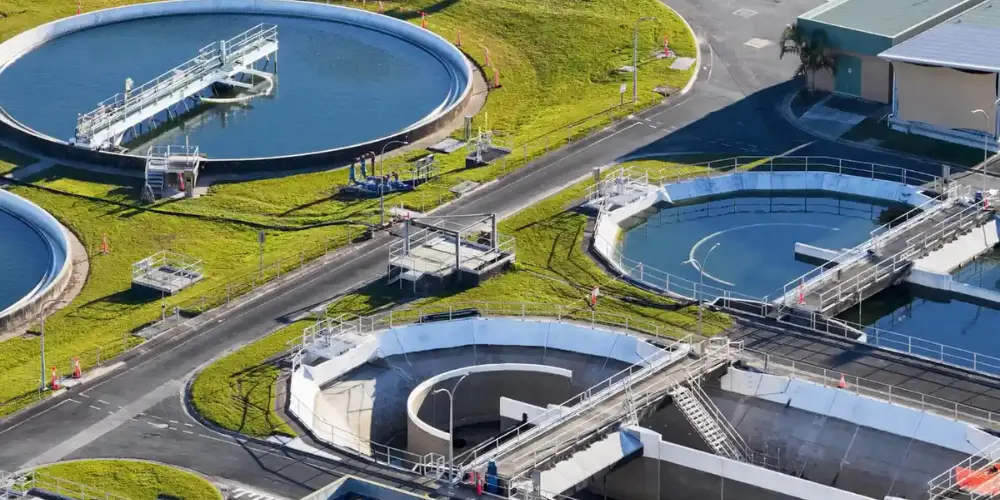
At the core of Dholera’s water infrastructure is a 50 MLD Water Treatment Plant (WTP) serving the Activation Area — the first developed phase of the region.
The plant takes raw water and moves it through a conventional multi-stage treatment sequence designed for bulk municipal and industrial supply:
- Intake and flow measurement — raw water is received and metered before treatment
- Coagulation and flocculation — chemical dosing binds suspended solids into larger particles
- Clarification — the large circular clarifiers visible in aerial views allow settled solids to separate out
- Filtration — remaining particulate matter is removed to bring turbidity within potable standards
- Disinfection — treated water is dosed before it enters the storage and distribution chain
The result is water that meets potable supply norms and can be dispatched at scale to every land-use category in the region.
Designed for Scalability: From 50 MLD to 150 MLD
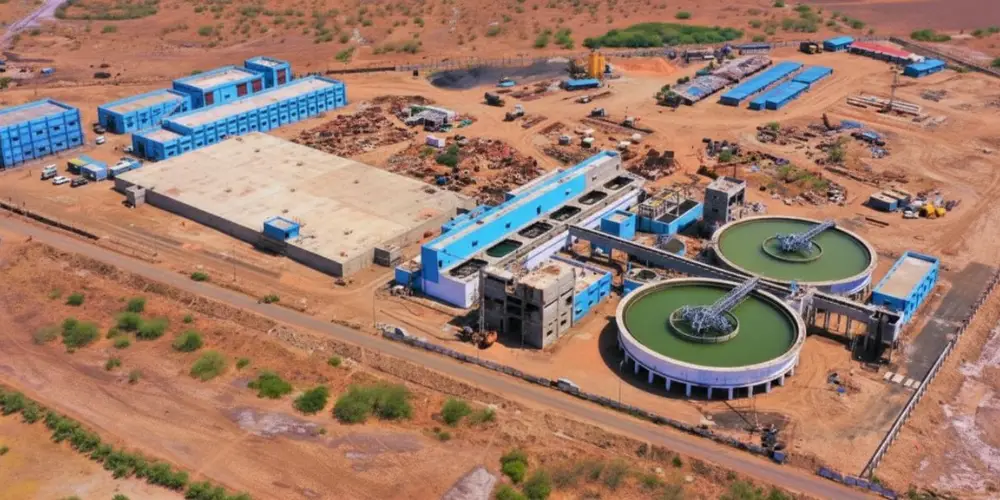
The most consequential design decision in the Dholera Water Treatment Plant is what hasn’t been built yet.
The plant has been planned for augmentation up to 150 MLD — three times its current rated capacity. Civil layouts, hydraulic design and land provisioning anticipate that expansion, so additional capacity can be added in modules rather than through a disruptive rebuild.
Why this matters:
- Demand tracks development. Capacity can be added as plots are allotted and occupied, avoiding stranded capital
- No supply ceiling for investors. An incoming anchor tenant is not negotiating against a fixed regional cap
- Phased capex. Expansion is sequenced with revenue-generating occupancy rather than front-loaded
For a city planned across decades, headroom is not a luxury — it is the difference between a utility that enables growth and one that caps it.
Mass Balancing Reservoirs: The Buffer Behind Reliable Supply
Once treated, water does not go straight into the network. It is first held in Mass Balancing Reservoirs (MBRs).
An MBR does exactly what its name suggests — it balances mass. Treatment plants run best at a steady output, while consumption swings sharply across the day. The reservoir absorbs that mismatch.
- Stores treated water between production and consumption
- Smooths peak-hour demand without forcing the WTP to surge
- Provides operational reserve during maintenance or intake interruptions
- Acts as the hydraulic starting point for the trunk distribution network
In practical terms, the MBR is why supply stays even when demand isn’t.
Elevated Service Reservoirs and the Piped Distribution Network
From the MBRs, water is distributed across the Activation Area through a piped supply network supported by multiple Elevated Service Reservoirs (ESRs).
ESRs are the tall storage structures that create gravity head. Instead of relying purely on pumping, elevation does the work — which is both more reliable and more energy-efficient.
Key features of the distribution layer:
- Multiple ESRs distributed across zones, so no single point serves the whole area
- Gravity-fed pressure delivering consistent flow to end users
- Dedicated utility corridors carrying water lines alongside other services, allowing maintenance without road excavation
- Zone-wise metering and monitoring enabling leak detection and demand tracking
This last point is underrated. Because Dholera’s utilities are laid in planned corridors, a pipeline repair does not mean digging up a functioning arterial road — a problem that plagues retrofitted cities.
Consistent Supply Across Industrial, Residential, Commercial and Institutional Zones
A well-structured system ensures consistent water pressure and reliable supply across all sectors of the Activation Area — industrial, residential, commercial and institutional.
That uniformity is deliberate. In most Indian cities, water reliability varies dramatically by neighbourhood and by hour. Dholera’s network is planned so that:
- Industrial plots receive process-grade volume without on-site treatment dependence
- Residential zones get continuous pressurised supply rather than intermittent tanker-supplemented service
- Commercial and institutional users — offices, schools, hospitals, hospitality — plan operations around a predictable utility
- Land value is not discounted by zone-level water uncertainty
What This Means for Investors and Industry
Infrastructure like this changes the arithmetic of an investment decision.
- Lower private capex. Less need for borewells, on-site storage or private treatment
- Faster commissioning. Utility connections exist ahead of the plot, not after it
- Regulatory comfort. Assured supply supports environmental clearances and operational compliance
- Long-term security. The 150 MLD augmentation path signals that supply will scale with the city
For land buyers and industrial investors evaluating Dholera SIR, the WTP is not a brochure line. It is evidence that trunk infrastructure has been delivered before demand — the single strongest indicator that a greenfield project is moving from plan to city.
Conclusion
The Dholera Water Treatment Plant is a quiet piece of infrastructure doing loud work. Fifty MLD today, a clear path to 150 MLD tomorrow, balanced through MBRs and delivered through ESRs and a planned piped network — it is the system that makes every other promise about Dholera credible.
Planning an investment in Dholera SIR? Talk to our team about plot availability and utility connectivity in the Activation Area.
Frequently Asked Questions
50 MLD, serving the Activation Area of Dholera SIR.
Yes — it is designed to be augmented up to 150 MLD.
Million litres per day, the standard measure of treatment plant output.
Storage that holds treated water and evens out daily demand swings.
They use gravity to keep water pressure consistent across the network.