


The Vibrant Gujarat Global Summit 2027 will be held in Gandhinagar from January 10 to 12. At the curtain-raiser in New Delhi, Chief Minister Bhupendra Patel held a round of global diplomatic conversations, and two themes dominated the room: semiconductors and data centres.
Both of those themes point to the same place on the map. Most of the Dholera updates coming out of the state right now are about chips, servers and the power to run them — and about whether any of it will translate into work for Gujarati youth.
What is actually happening in Dholera right now?
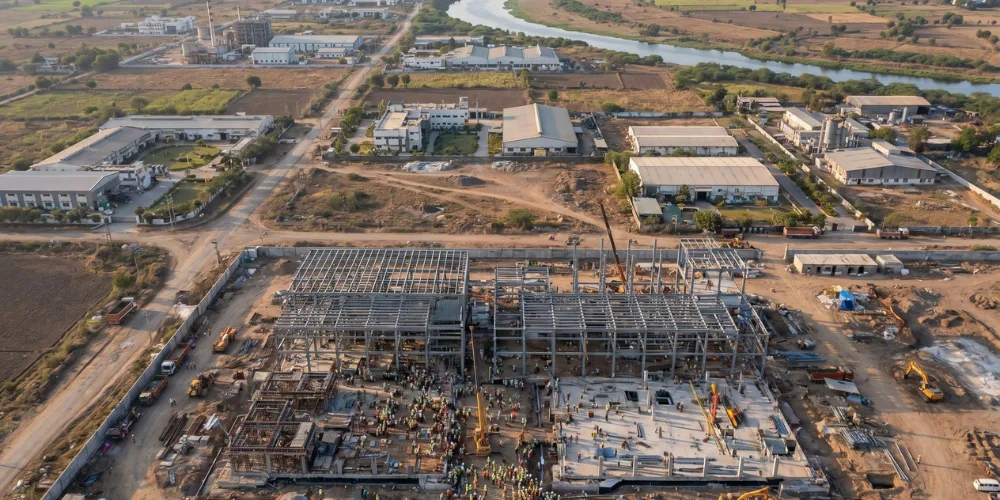
Dholera Special Investment Region (SIR) has spent a decade being described as a future city. In 2026 it started behaving like a construction site with deadlines.
The anchor project is the Tata Electronics–PSMC semiconductor fab, cleared by the Union Cabinet in February 2024 at roughly ₹91,000 crore. It is designed for up to 50,000 wafers a month, starting at the 28nm node — chips for power management, display drivers, microcontrollers and automotive electronics. As of April 2026, the site was reported at about 50% construction completion, with foundation work done and the harder phases beginning: cleanroom installation, equipment integration and process calibration.
The much-repeated line is that India’s first commercially fabricated chip rolls out of Dholera in December 2026, with commercial volumes through 2027. Treat that as a target rather than a certainty. Fabs are among the slowest industrial projects in the world to commission, and slipped timelines are the norm globally, not a scandal.
Around the fab, a supply chain is forming. Fujifilm India has signed an MoU with the state to explore supplying ultra-pure process chemicals. Packaging and assembly players are scouting the corridor. Dholera’s international airport was reported at roughly 80% completion in mid-2026, and a semi-high-speed rail link to Ahmedabad is planned.
Where does ₹7 lakh crore come from?
The headline number is not one cheque. It is the sum of two policy pushes that both land heavily on Dholera.
The larger share is digital. In July 2026, Gujarat launched the Viksit Gujarat Data Centre Policy 2026–29 — the first dedicated data centre policy by any Indian state. The government said it had already received proposals from around 14 companies and expects more than ₹6 lakh crore of investment in the first phase, targeting 7.5 GW of capacity. Officials indicated Dholera alone could host a cluster of 7 to 8 GW.
The smaller but strategically heavier share is silicon. Between the Tata fab in Dholera and units at Sanand, Gujarat has become the centre of India’s chip programme. At the Delhi curtain-raiser, CM Patel said six of the twelve semiconductor projects approved nationally are in Gujarat, with three facilities already operational.
Add the committed and proposed capital across both streams and you arrive at the ₹7 lakh crore ballpark now being quoted ahead of VGGS-2027.
The incentives behind it are aggressive, and Dholera gets its own line item: a 2.5% capital subsidy on eligible fixed capital investment in the Dholera region, interest subsidy of up to 4% on term loans capped at ₹25 crore a year, a ₹1 per unit power tariff subsidy for twenty years, full stamp duty and registration exemption, and SGST reimbursement for up to two decades. In return, developers must source at least 51% of operational electricity from renewables and meet water needs through captive desalination rather than draw down local freshwater.
One deal already shows the shape of things. In February 2026, L&T Vyoma signed on to build a 250 MW green AI data centre in Dholera at ₹25,000 crore, targeting operations by 2028.
Is Gujarat set to become a tech hub?
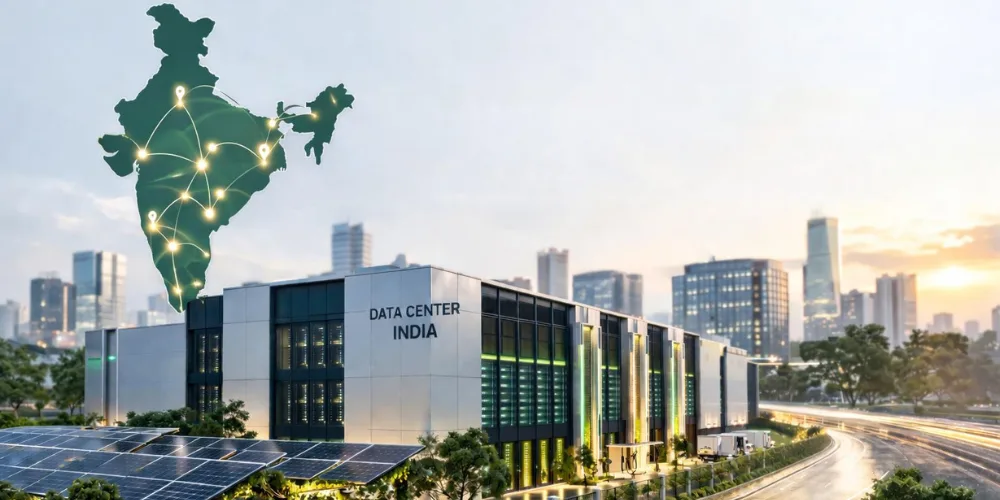
Yes — and the shift is already underway, though it is a shift in addition to the old economy rather than a replacement of it.
Gujarat’s industrial identity has been brass parts in Jamnagar, diesel engines in Rajkot, textiles in Surat and Ahmedabad, and diamonds. None of that is going away. What is new is a second layer being built on top: fabs, hyperscale compute, green hydrogen, GCCs and fintech, echoing the tech clusters emerging in states like Andhra Pradesh and Telangana.
Dholera is the clearest expression of that second layer, because it was designed for it — large contiguous land parcels, planned utilities, port and expressway connectivity, and now an airport.
Will this create jobs for Gujarati youth?
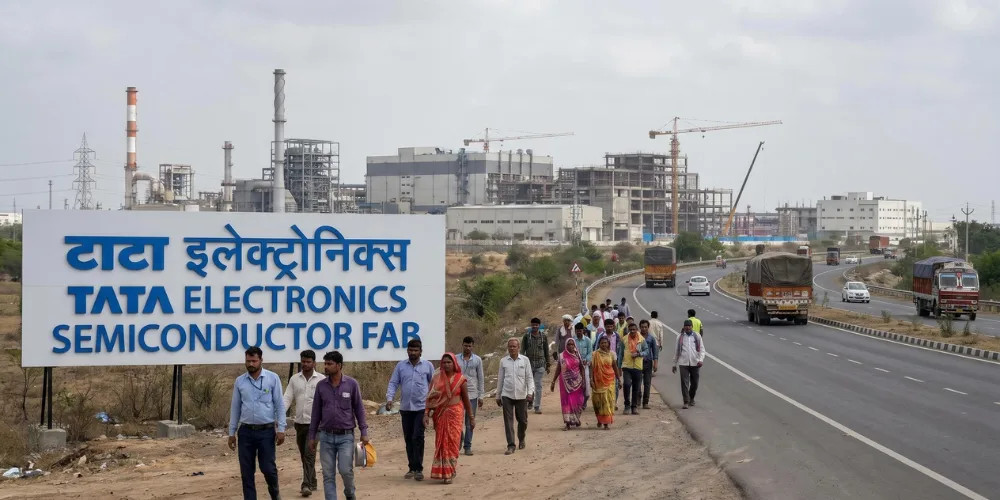
This is the question that matters, and it deserves an honest answer rather than a brochure one.
Yes, jobs are coming. The Tata fab alone is estimated to generate over 20,000 direct and indirect roles. Data centre construction at multi-gigawatt scale is enormously labour-intensive. Ancillary demand — chemicals, precision engineering, logistics, warehousing, facility management, housing and food services around Dholera — will likely employ more people than the marquee plants themselves.
But three caveats are worth stating plainly.
One: the job mix is lopsided. Construction employment is large and temporary. Operational employment at a fab or a hyperscale data centre is smaller and highly specialised — process engineers, metrology technicians, cleanroom staff, network and power engineers. A running data centre needs far fewer people per crore invested than a textile mill does.
Two: the skills gap is real. Semiconductor process roles need diploma and degree holders trained on specific equipment. Whether Gujarati youth capture these roles or watch them go to candidates from Bengaluru, Hyderabad and Taiwan depends almost entirely on how fast ITIs, polytechnics and engineering colleges in the state retool their curricula and build fab-adjacent lab capacity.
Three: numbers announced are not numbers delivered. MoU value and realised investment are different things, and Vibrant Gujarat has a long history of the gap between the two. The honest way to read ₹7 lakh crore is as a pipeline, not a payroll.
What to watch before January 2027
Four checkpoints will tell you whether the Dholera story is converting from announcement to output: whether the first wafer actually comes out of the Tata fab; how many of the 14 data centre proposals convert into signed land allotments; whether the airport opens on schedule; and how much of the state’s skilling budget is aimed specifically at semiconductor and data centre roles.
If those four move, the jobs argument gets much stronger. VGGS-2027 in January will be the first real scoreboard.